
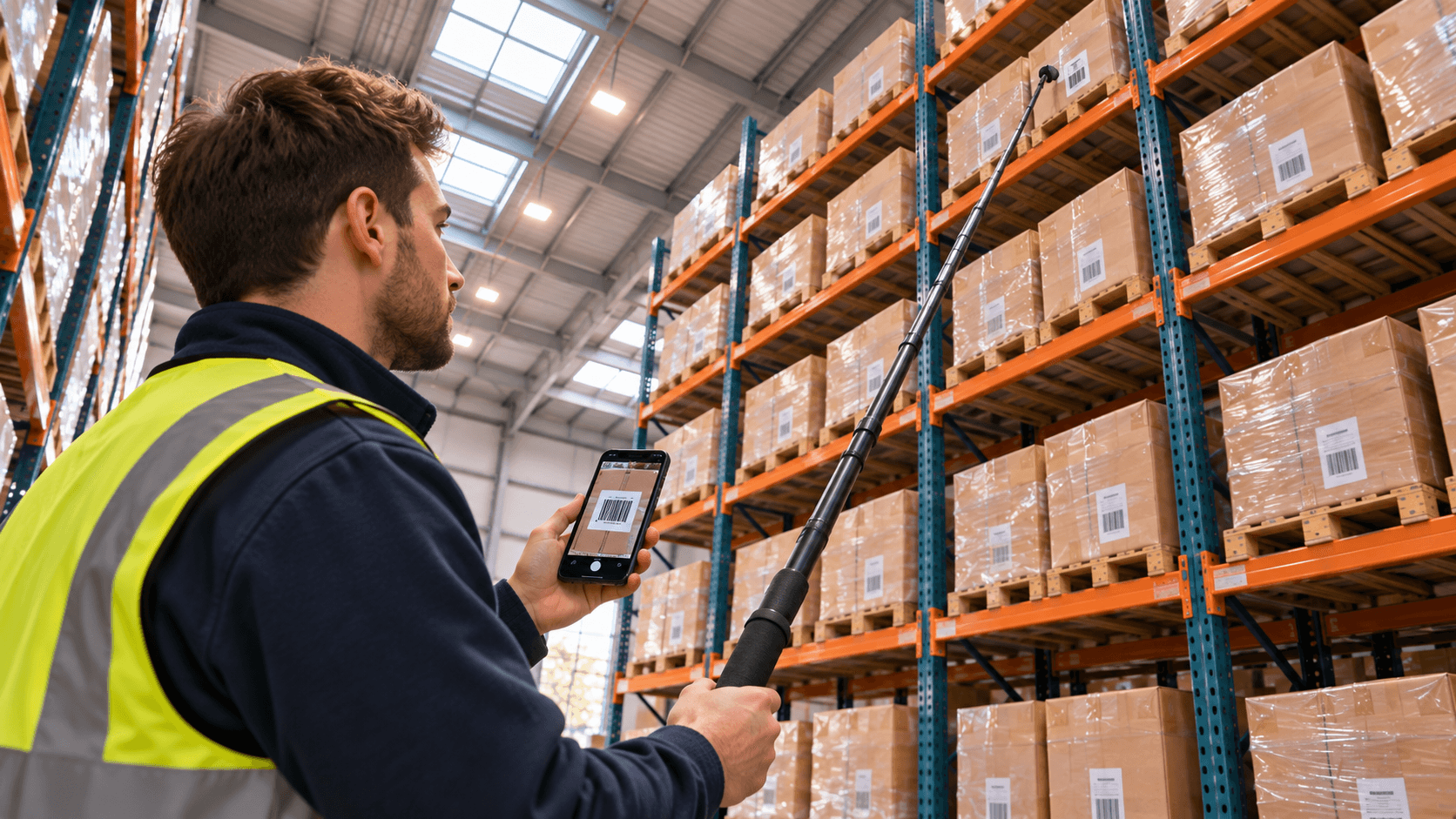
Stocktaking starts with identifying what is stored and where. The major challenge is reading labels high above ground level—around the fifth rack level, rather than only the first or second. Lowering a carton just to scan its label—and returning it afterward—adds handling to a task that primarily needs information.
Our camera-based proof of concept (POC) explored a different approach: bring the camera closer to the label while the goods stay on the rack.
What we tested
We tested a pole-mounted camera in a warehouse, with the camera view available on a mobile device at ground level. The pole brings the camera within viewing distance of an accessible label; the mobile screen lets the operator check the framing and readability before capturing an image.
The practical idea is simple: position the camera, view the label, capture the evidence and review it. Depending on pole length and handling conditions, one person can position the camera while a colleague monitors the device. The setup should be adapted to the task, rather than assuming one person can manage every operating height.
The POC demonstrated the camera-and-mobile approach. This article does not report measured label-reading accuracy, time savings or energy savings, or claim validation across all rack heights and warehouse conditions.
From label image to verified stock record
The captured image is the starting point for the stock-checking workflow:
- Capture: photograph the visible label and record its rack or bin location, with a timestamp.
- Save: retain the original image so it can be checked alongside the extracted data.
- Read: use barcode decoding, OCR or AI to extract identifiers from the image.
- Reconcile: compare those identifiers with inventory records; review unclear images, unmatched codes and possible duplicates.
- Confirm: correct exceptions and save verified observations in the application.
Camera capture and data interpretation are separate steps. A clear image still needs a reliable match to the right stock record. Where the capture application supports local storage, images can be saved for later processing or synchronization. Offline capture does not automatically mean that AI processing also works offline.
What a label can—and cannot—confirm
An image can support an observation that a labelled carton was present at a particular location and time. It cannot by itself verify the contents, quantity inside, condition of the materials or cartons hidden behind other goods.
A label that cannot be seen should remain an exception to investigate, rather than automatically becoming “stock absent.” Physical checks remain part of the warehouse’s stocktaking process.
Adapt the idea to your warehouse
Live implementation needs suitable camera resolution, focus, lighting, cable management and device compatibility. At upper rack levels, pole reach and stability, camera positioning and label readability become central challenges. Aisle access and the warehouse’s handling procedures also matter. Validate the setup under the conditions in which it will actually be used.
A useful rollout compares the same stock-checking task before and after: how many labels are captured clearly, how many match correctly, which need manual review, and how much time and equipment use are involved. Less carton movement may reduce handling and energy use, but those benefits need measurement.
A manual pole is one implementation. Motorized masts, fixed cameras or other camera platforms are options for separate evaluation—not configurations demonstrated by this POC.
The aim is to improve the existing process: spend less effort bringing labels to a scanner and more time validating data and resolving stock discrepancies.
Proof-of-concept note: This workflow has been tested as a proof of concept (POC). Implementation in a live warehouse requires adapting and validating it against your own operational needs, systems and working conditions. The POC demonstrates the idea; results will depend on the implementation.
The cover is an AI-generated illustration of the concept, with a fictional worker and unbranded workwear. It is not a photograph of the actual POC.
Explore the series
- Why Move a Box Just to Read Its Label? (you are here)
- Snap a PO Document. Let AI Prepare Your PO Entry.
- Snap a CIPL. Let AI Prepare Your GRN Entry.